Tech Note: Deep Dive into UHF RFID PC (Protocol Control) Value Format
When developing UHF RFID systems, you frequently encounter hex values like 3000h or 3400h. These are PC (Protocol Control) Values. Although only 16 bits long, the PC value acts as the "translator" that tells the RFID reader how to interpret the tag's data.
If you have ever faced issues with truncated EPC reads or encountered errors when writing new IDs, understanding the PC value structure is essential.
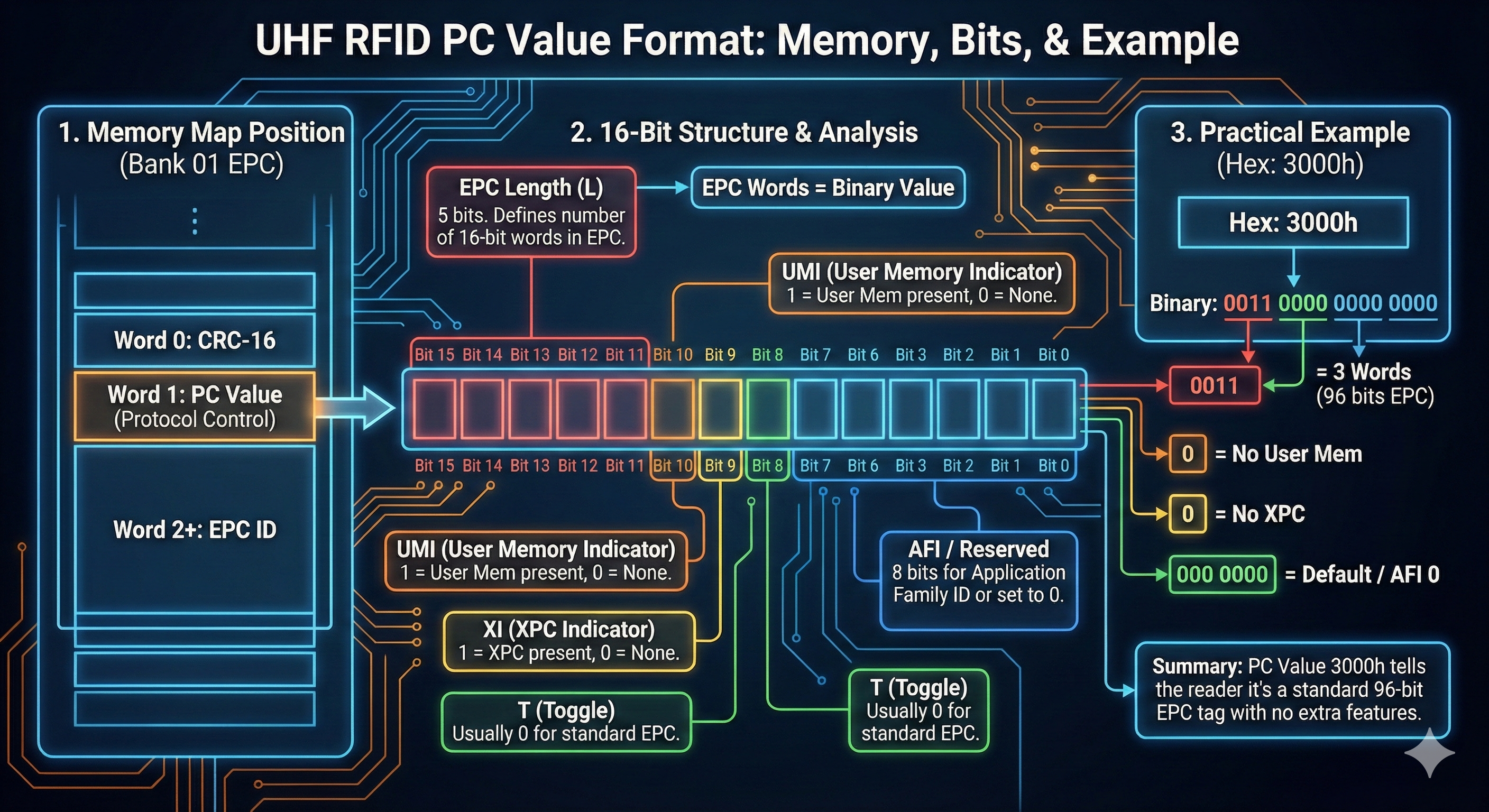
1. Where is the PC Value? Memory Map Position
In the EPC Gen2 standard, tag memory is divided into four banks. The PC value is located at the very beginning of Bank 01 (EPC Bank):
- Word 00: CRC-16 (Cyclic Redundancy Check)
- Word 01: PC Value (Our Focus)
- Word 02 ~ n: EPC ID (Electronic Product Code)
When a reader executes an "Inventory" command, it reads the PC value first to determine exactly how many words of EPC data follow.
2. 16-Bit Structure Breakdown
Let's dissect these 16 bits (from Bit 15 down to Bit 0). Each segment has a specific role:
| Bit Range | Abbreviation | Description |
|---|---|---|
| 15 – 11 | L | Length Indicator: Defines the number of 16-bit words in the EPC. |
| 10 | UMI | User Memory Indicator: 1 = User Memory exists, 0 = None. |
| 9 | XI | XPC Indicator: 1 = Extended PC bits are present, 0 = None. |
| 8 | T | Toggle Bit: Usually set to 0 for standard EPC applications. |
| 7 – 0 | AFI | Application Family Identifier: Used to categorize tag types (Default is 00h). |
3. Case Study: Why is 3000h the Industry Standard?
For a standard 96-bit EPC tag, the PC value is almost always 3000h. Let's reverse-engineer this from Hex to Binary:
Hex 3000h to Binary:
00110 (Bits 15-11) | 0 (Bit 10) | 0 (Bit 9) | 0 (Bit 8) | 0000 0000 (Bits 7-0)
Key Calculations:
- EPC Length (L): The first 5 bits are
00110.- Binary
00110= Decimal 6. - This means the EPC consists of 6 Words.
- Total Bits: $6 \times 16 = 96$ bits.
- Binary
- Indicators: UMI, XI, and T are all
0, indicating a standard tag with no special features flagged in the PC word. - AFI: Set to
0000 0000, the default for general-purpose applications.
4. Development & Troubleshooting Tips
When coding RFID software (using C#, Python, or Java SDKs), a mismatched PC value is a common source of bugs:
- Truncated Data: If the PC value length (L) is set shorter than the actual EPC, the reader will only return a partial ID.
- Write Failures: When changing an EPC length (e.g., from 96-bit to 128-bit), you must update the PC value simultaneously. Otherwise, the tag may become "invisible" to standard inventory scans.
- User Memory Check: While the UMI bit indicates if User Memory exists, you still need specific "Read" commands targeting Bank 03 to access that data.
Conclusion
The PC value is a small but mighty part of the RFID protocol. By understanding its bit-level structure, you can better diagnose hardware behavior and build more robust automation systems. Whether you are managing warehouse logistics or asset tracking, mastering the PC value ensures your data remains accurate and accessible.